
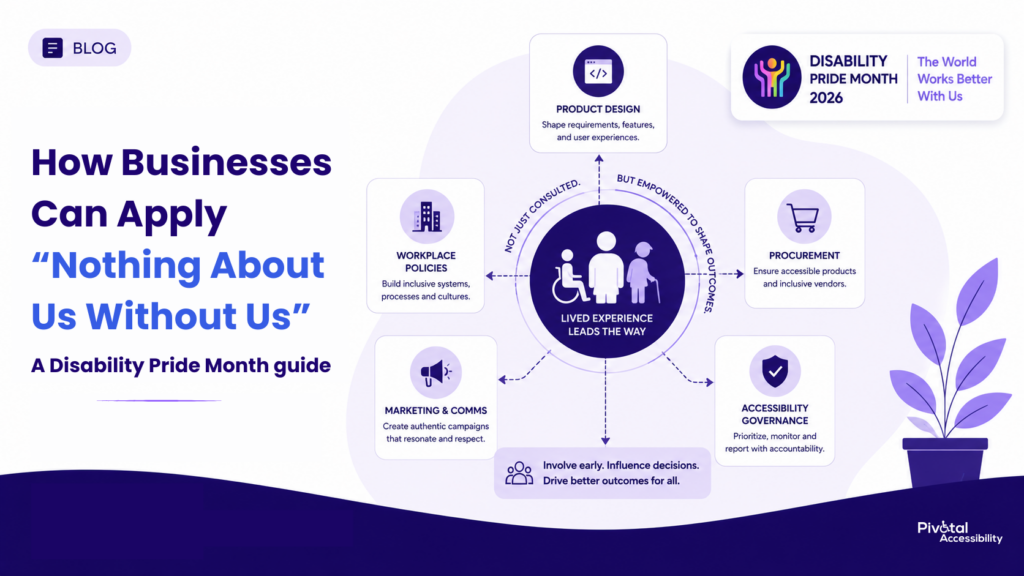
“Nothing About Us Without Us” is a disability-rights principle that calls for disabled people to have meaningful influence over decisions that affect them. The principle is reflected in Article 4(3) of the United Nations Convention on the Rights of Persons with Disabilities, which requires governments to closely consult with and actively involve people with disabilities in relevant decision-making. Businesses can apply “Nothing About Us Without Us” by involving disabled people before product requirements, workplace policies, procurement decisions, marketing campaigns and accessibility priorities are finalised.
The principle is especially relevant during Disability Pride Month. The 2026 theme, “The World Works Better With Us,” asks organisations to look beyond disability visibility and consider whether disabled people are recognised as customers, employees, professionals and decision-makers whose knowledge can shape business outcomes.
According to the World Health Organization, approximately 1.3 billion people, or 16% of the global population, experience significant disability. Yet many decisions affecting disabled customers and employees are still made without their direct participation. For businesses, the central question is therefore not simply whether disabled people were consulted, but whether their participation had enough influence to change the decision.
For businesses, the important word is not simply involvement. It is an influence.
“Nothing About Us Without Us” means disabled people should help shape the business decisions that affect them. This includes product requirements, accessibility testing, workplace systems, procurement, marketing, and governance. Meaningful participation must happen early enough to change the outcome, rather than being limited to feedback on decisions that have already been made.
What Does “Nothing About Us Without Us” Mean?
“Nothing About Us Without Us” is a central principle of the disability rights movement. It rejects the assumption that other people can make informed decisions for disabled people without their direct participation.
The principle is reflected in Article 4(3) of the United Nations Convention on the Rights of Persons with Disabilities. It requires States Parties to closely consult with and actively involve people with disabilities, including through their representative organisations, in decisions concerning them. The Committee on the Rights of Persons with Disabilities later clarified the importance of this participation in General Comment No. 7.
That obligation is directed at governments implementing the Convention. It should not be misrepresented as a universal legal rule applying identically to every private business. However, the underlying governance principle is highly relevant to organisations whose products, services, policies, and technologies affect disabled people.
It asks a straightforward question:
Were disabled people able to influence the decision, or were they invited only after the important choices had already been made?
Why This Principle Matters During Disability Pride Month
Disability Pride Month is observed every July to recognise disability identity, culture, leadership and civil rights. The 2026 theme, “The World Works Better With Us,” was selected by The Arc’s National Council of Self-Advocates, a disabled-led council.
The theme provides a useful challenge for businesses. It is easy to interpret the word “with” as a general call for inclusion. It’s more demanding interpretation concerns power.
Working with disabled people means recognising them as:
- Customers with valuable knowledge about product barriers
- Employees with expertise relevant to workplace decisions
- Researchers, designers, developers, and accessibility professionals
- Business owners, leaders, and decision-makers
- Members of disability-led organisations with collective knowledge
- Participants who should be paid for their time and expertise
Disability Pride Month, therefore, allows organisations to look beyond representation. The question is not simply whether disabled people appear in a campaign or participate in an event. The question is whether their knowledge affects how the business operates.
The Difference Between Visibility and Influence
A business may feature disabled people in advertising, invite a disabled speaker to an event or conduct a single accessibility testing session. These actions can have value, but they do not necessarily satisfy the principle of “Nothing About Us Without Us.”
A useful way to examine participation is to consider five levels.
From Visibility to Disability Leadership
| Level | What it looks like | Main limitation |
|---|---|---|
| Visibility | Disabled people appear in campaigns, reports, or public communications. | Representation may not affect the underlying product or policy. |
| Access | Disabled people can use the service, attend the event, or participate in the process. | Access allows participation but does not guarantee influence. |
| Consultation | Disabled people are asked about their experiences or preferences. | The organisation may still retain complete control over the questions and decisions. |
| Influence | Feedback changes requirements, priorities, designs, or policies. | Influence may remain limited to individual projects. |
| Leadership | Disabled people hold recurring roles in governance, delivery, and decision-making. | Leadership must still reflect diversity across disability experiences. |
The objective is not to claim that every disabled participant must have authority over every business decision. The objective is to ensure that participation is proportionate to the decision and capable of changing the outcome.
A one-hour consultation cannot compensate for the absence of disabled people from months of research, planning, and development.
Where Businesses Should Apply “Nothing About Us Without Us”
The principle has implications across the organisation. It should not sit exclusively with a diversity team, employee resource group, or accessibility specialist.
1. Product Research and Requirements
Businesses make early decisions that determine what a product will do, whose needs it will prioritise and which journeys will receive the most attention.
This stage may include:
- Defining the target audience
- Selecting primary user journeys
- Establishing business and functional requirements
- Choosing devices and platforms to support
- Deciding which barriers are considered critical
- Determining the budget and delivery schedule
When disabled people are absent from discovery, their requirements may enter the project later as exceptions. Accessibility then becomes a collection of adjustments to a product whose underlying assumptions were never examined.
Early participation can reveal issues that are difficult to identify from technical standards alone. For example, a team developing an online financial service may meet individual interface requirements while overlooking how identity verification, time limits, document uploads, and account recovery interact during a complete journey.
The Web Accessibility Initiative recommends involving disabled people early and throughout digital projects. This can help teams understand real-world use of assistive technologies and adaptive strategies before designs and technical decisions become expensive to change.
A practical business test
Before approving requirements, ask:
Which assumptions about disabled users were verified with disabled people, and which remain internal assumptions?
2. Design, Development, and Accessibility Testing
Disabled-user involvement is especially valuable during prototyping, design reviews, and task-based testing. It can reveal whether people can understand an interaction, recover from an error, and complete a journey using their usual technology.
However, “Nothing About Us Without Us” does not mean that user testing should replace formal accessibility evaluation.
The World Wide Web Consortium warns against assuming that one disabled person’s experience applies to everyone with the same disability. It recommends involving a range of users and combining their input with evaluation against the Web Content Accessibility Guidelines. A small user study can identify serious barriers, but it cannot establish conformance for all disability groups and usage contexts.
A credible accessibility process, therefore, brings together:
- Disabled users with relevant lived experience
- Accessibility professionals with knowledge of WCAG
- Manual and automated testing
- Assistive technology evaluation
- Designers, developers, and quality assurance professionals
- Product owners who can act on the findings
These perspectives serve different purposes. A screen reader user may demonstrate that a transaction cannot be completed. An accessibility specialist can determine whether the cause involves incorrect code, interaction design, browser behaviour, assistive technology or a combination of factors.
W3C describes this as the use of combined expertise in accessibility evaluation. Pivotal Accessibility has also examined why testing must account for experiences that conventional methods can overlook, including in its analysis of accessibility testing for combined sensory loss.
3. Workplace Technology and Employee Policies
Disabled employees are often consulted about individual accommodations but excluded from broader decisions that create the need for those accommodations.
These decisions may concern:
- Recruitment and applicant-tracking systems
- Internal communication platforms
- Learning management systems
- Attendance and productivity policies
- Hybrid working arrangements
- Office and event technology
- Emergency and business continuity planning
An organisation may resolve one employee’s immediate problem without addressing the inaccessible system affecting current and future employees.
Businesses should give disabled employees safe and accessible ways to contribute to system selection, policy design, and workplace reviews. Participation should not depend on public disclosure. Some employees may not identify as disabled at work, may not require an accommodation, or may not want to discuss personal information with colleagues.
Employee resource groups can provide useful insight, but they should not become unpaid accessibility departments. Responsibility for accessible procurement, testing, remediation, and policy compliance must remain with the appropriate business owners.
4. Marketing and Disability Representation
Disability Pride Month often increases the visibility of disabled people in corporate communication. Representation matters, particularly when disability has historically been excluded, stereotyped or presented only through charity and inspiration.
Representation becomes questionable when the surrounding experience is inaccessible.
Examples include:
- A Disability Pride video without accurate captions
- A campaign image without useful alternative text
- An inaccessible event registration form
- A recruitment campaign linked to an inaccessible application portal
- A downloadable report that cannot be used with a screen reader
- A campaign developed around disabled people without disabled contributors
A disabled person appearing in the final creative is not evidence that disabled people influenced the campaign.
Marketing teams should involve disabled contributors during concept development, production, and accessibility review. This does not mean asking a single participant to approve all disability representation. It means creating a process in which relevant perspectives can identify stereotypes, access barriers, and unintended messages before publication.
The campaign journey should also be assessed as a whole. An accessible social post does not resolve an inaccessible landing page, form, document, or event platform.
5. Procurement and Third-Party Technology
Businesses increasingly deliver digital services through products they did not build. Customer journeys may depend on payment gateways, authentication tools, chatbots, document platforms, booking systems and embedded third-party components.
Disabled customers do not experience these organisational boundaries. They experience one journey.
The principle of “Nothing About Us Without Us” can improve procurement when disabled users and accessibility specialists help:
- Define accessibility requirements
- Review vendor documentation
- Evaluate demonstrations
- Test critical tasks
- Establish acceptance criteria
- Assess product updates
- Inform renewal or replacement decisions
An Accessibility Conformance Report or Voluntary Product Accessibility Template can provide valuable information, but it should not be treated as independent proof that the product will work in the organisation’s intended context.
Participation is particularly important when vendors describe a workaround as an accessible alternative. Disabled users can help determine whether that alternative preserves functionality, privacy, independence, and choice.
Procurement should sit within a wider digital accessibility strategy that assigns ownership and integrates accessibility into delivery, testing and governance.
6. Accessibility Governance and Prioritisation
Businesses commonly involve disabled people in research but exclude them from prioritisation.
A barrier may be documented accurately and remain unresolved because the organisation classifies it as low priority. Technical severity models can overlook effects such as:
- Loss of privacy
- Forced dependence on another person
- Exclusion from a time-sensitive opportunity
- Inability to recover from an error
- Greater physical or cognitive effort
- Exposure of personal or financial information
- Complete abandonment of the service
Disabled users should not be solely responsible for setting severity, but their experience should inform the decision.
Accessibility governance should establish how user impact affects:
- Defect classification
- Remediation priorities
- Release decisions
- Risk acceptance
- Exceptions and temporary workarounds
- Product roadmap commitments
This is where participation becomes accountability. Feedback must enter a process with an owner, a decision, and a traceable outcome.
As Pivotal Accessibility has previously argued, sustainable accessibility requires systems rather than empathy alone. Good intentions cannot preserve accessibility through changing products, teams, and vendors.
What Meaningful Disability Participation Does Not Mean
Businesses can misuse “Nothing About Us Without Us” by treating any interaction with a disabled person as sufficient participation.
The principle is not satisfied by:
Asking one person to represent every disability
Disability is not a single user characteristic. People with similar impairments may use different technologies, have different levels of experience, and encounter different barriers.
Inviting feedback after the decision is final
Consultation becomes symbolic when budgets, requirements, designs, and deadlines can no longer change.
Replacing technical evaluation with lived experience
Disabled users provide essential knowledge about actual use. Formal accessibility testing provides systematic coverage across standards, technologies, and disability groups. A mature process uses both.
Expecting unpaid expertise
A person invited to advise, test, train, or review is contributing knowledge. Businesses should budget for that contribution, just as they would for other professional research or consulting.
Making the participation process inaccessible
Research platforms, documents, meetings, consent processes, and payment systems must themselves be accessible. Participants should be asked what adjustments or communication formats they require.
Collecting feedback without closing the loop
Participants should be told what was changed, what could not be changed, and why. Silence tells contributors that the organisation wanted their presence more than their influence.
How Businesses Can Put the Principle Into Practice
A practical implementation process can begin with seven questions.
1. Which decisions affect disabled people?
Map decisions across products, employment, procurement, marketing, customer support, and business continuity. Do not limit the exercise to projects already labelled as accessibility initiatives.
2. Who should participate?
Match participants to the affected audience and decision. This may involve disabled employees, customers, accessibility professionals, independent researchers, or organisations of persons with disabilities.
United Nations guidance distinguishes organisations of persons with disabilities from organisations that merely provide disability-related services. Organisations of persons with disabilities are led, directed and governed by disabled people and exist to promote or defend their rights. This distinction matters when a business needs representative, disability-led input rather than advice delivered on behalf of disabled people.
3. When can participation still change the outcome?
Involvement should begin before requirements and preferred solutions become fixed. Continue it through design, development, evaluation, and post-launch monitoring.
4. What will participants be able to influence?
State this clearly. Participants should know whether they are advising on a prototype, selecting between alternatives, defining requirements, or contributing to a formal decision.
5. What access and compensation are required?
Plan accessible materials, communication support, assistive technology compatibility, flexible scheduling, and payment arrangements before recruitment begins.
6. How will lived experience and technical expertise be combined?
Document how user findings will be assessed alongside WCAG conformance, platform requirements, legal obligations, security, and product constraints.
7. How will the business report what changed?
Record decisions, owners, deadlines, and unresolved risks. Communicate outcomes to participants and affected teams.
Measure Influence, Not Attendance
The number of consultation sessions is an activity measure. It does not show whether participation improved the decision.
Businesses should consider measures such as:
| Measure | What it reveals |
|---|---|
| Percentage of major research rounds involving relevant disabled participants | Whether participation is built into the product process |
| Requirements changed because of disabled-user input | Whether consultation affects decisions |
| Accessibility barriers identified before development | Whether early involvement is reducing avoidable rework |
| Time taken to resolve high-impact user-reported barriers | Whether the feedback process has operational ownership |
| Repeated accessibility defects across releases | Whether lessons are being retained |
| Percentage of accessibility feedback receiving a documented response | Whether the organisation closes the loop |
| Disabled representation in recurring governance roles | Whether participation extends beyond one-off projects |
| Participant assessment of the research process itself | Whether the organisation made participation accessible and respectful |
These measures should not be used to turn disabled people into a performance statistic. Their purpose is to test whether the organisation’s process gives participation practical effect.
Four Questions for Disability Pride Month
Businesses marking Disability Pride Month can use the occasion to review their own practices.
- Who shaped this initiative?
Were disabled people involved in deciding what the organisation would say and do? - Can disabled people access the complete experience?
Review the campaign, event, landing page, registration process, videos, documents and follow-up communication. - What changed because disabled people participated?
Identify a requirement, policy, design or priority that changed through their contribution. - What will continue after July?
Convert the initiative into a recurring research, governance, employment or accessibility practice.
The 2026 Disability Pride Month theme states that “The World Works Better With Us.” For businesses, that should be understood as more than a statement of belonging. It is a standard for how decisions are made.
From Consultation to Shared Responsibility
“Nothing About Us Without Us” does not ask businesses to transfer every accessibility decision to disabled customers or employees. It asks them to stop treating disabled people as distant beneficiaries of decisions made elsewhere.
The business value of the principle lies in better information, earlier identification of risk, and a more accurate understanding of how products and policies work in practice. Its deeper value lies in recognising disabled people as participants with agency and expertise.
Meaningful participation requires more than an invitation. It requires accessible processes, appropriate compensation, technical rigour, diverse perspectives and a credible path from feedback to action.
A business applying the principle should be able to answer one final question:
What decision changed because disabled people were in the room?
Pivotal Accessibility helps organisations combine accessibility standards, manual and assistive technology testing, user-focused evaluation and sustainable governance. Explore our digital accessibility services or contact Pivotal Accessibility to discuss how disabled-user perspectives can be incorporated into a rigorous accessibility programme.