
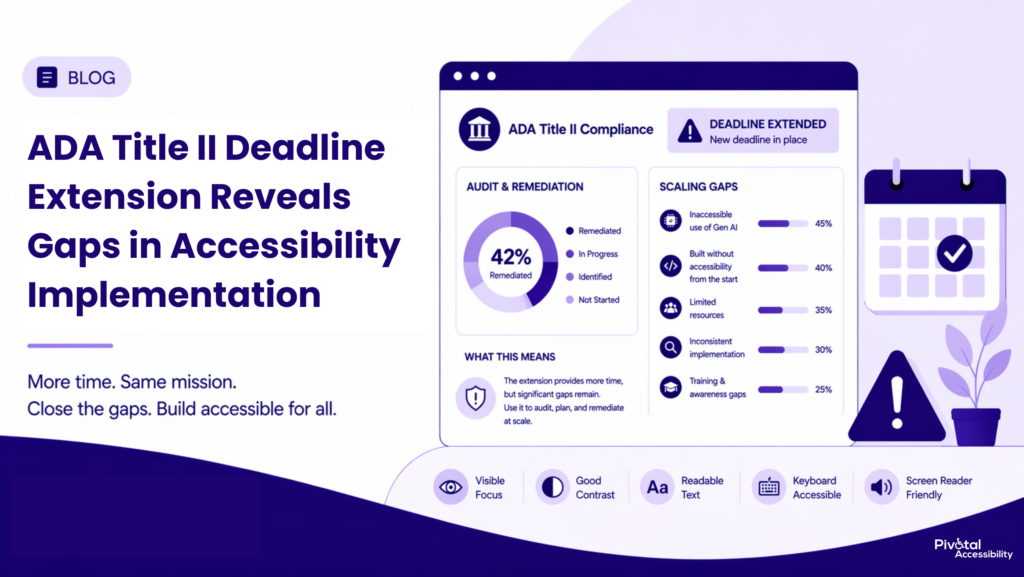
The ADA Title II deadline extension, issued by the U.S. Department of Justice through an Interim Final Rule on April 20, 2026, extends compliance timelines for web and mobile accessibility by one year.
- Public entities serving populations of 50,000 or more: Extended from April 24, 2026, to April 26, 2027.
- Public entities serving populations under 50,000: Extended from April 26, 2027, to April 26, 2028.
The Department explicitly acknowledges that it “overestimated the capabilities (whether staffing or technology) of covered entities to comply with the rule in the time frames provided.”
Apart from being a timeline extension, this is also an indication that current accessibility implementation models are not scaling as expected.
In this blog, we examine what the extension reveals about the gaps in how organizations approach accessibility implementation, and what can be done to reduce the risk of non-compliance as the revised deadlines approach.
ADA Title II Deadline Extension Reflects Systemic Execution Constraints
The Interim Final Rule identifies multiple constraints affecting compliance, including:
- Staffing limitations
- Resource constraints
- Gaps in available technology
The Department notes that these challenges arise from “circumstances outside of the Department’s and covered entities’ control.”
It also observes that “advanced technology, such as generative AI, does not yet reliably automate the remediation of inaccessible content at scale.”
These observations indicate that accessibility challenges are not limited to effort or intent. They are rooted in how accessibility work is structured relative to evolving digital systems.
ADA Title II Deadline Extension and the Accessibility Backlog Problem
A critical passage in the Interim Final Rule states, “Covered entities have been generating substantial amounts of content… using generative AI… that is potentially inaccessible.”
This highlights a structural issue. Accessibility outcomes depend on two opposing dynamics:
- Remediation of existing issues
- Introduction of new inaccessible content
The IFR confirms that content generation, including through generative AI, is increasing. At the same time, the WebAIM 2026 survey shows that website complexity is also rising. The average number of page elements increased to 1,437 per home page in February 2026, a 22.5% increase in just one year. This combination increases both the likelihood and frequency of inaccessible patterns being introduced.
In such an environment, remediation efforts are required to address not only a growing volume of issues but also issues embedded within increasingly complex structures, making sustained backlog reduction significantly more difficult.
The ADA Title II deadline extension reflects this imbalance, even if it is not explicitly framed in these terms.
ADA Title II Deadline Extension Shows Why Timelines Alone are Insufficient
Extending deadlines increases available time, but it does not change how accessibility issues are produced.
The IFR warns that unrealistic timelines may lead to inefficient or rushed implementation. However, the inverse is equally important.
If production systems continue to introduce inaccessible content:
- The volume of issues increases
- Remediation efforts are diluted
- Compliance timelines become less meaningful
This explains why accessibility programs often struggle to demonstrate sustained progress despite ongoing investment.
It is also important to note that the obligation to maintain compliance with WCAG 2.1 Level A and AA remains unchanged despite the extended timelines. If inflow remains constant or increases, remediation efforts will not lead to sustainable compliance.
ADA Title II Deadline Extension and the Limits of Reactive Approaches to Accessibility
The Interim Final Rule further notes that “the less public entities can rely on technology… the more they will need to rely on manual work instead.”
This highlights a structural limitation in how accessibility is currently implemented.
Most accessibility programs are built around:
- Audits
- Remediation
- Compliance validation
These approaches are inherently reactive. They operate after content has already been created.
At scale, this creates a fundamental mismatch.
Digital systems continuously produce new content, while accessibility efforts struggle to keep up with previously introduced content. As content production accelerates, particularly through automated and generative systems, remediation alone cannot keep pace.
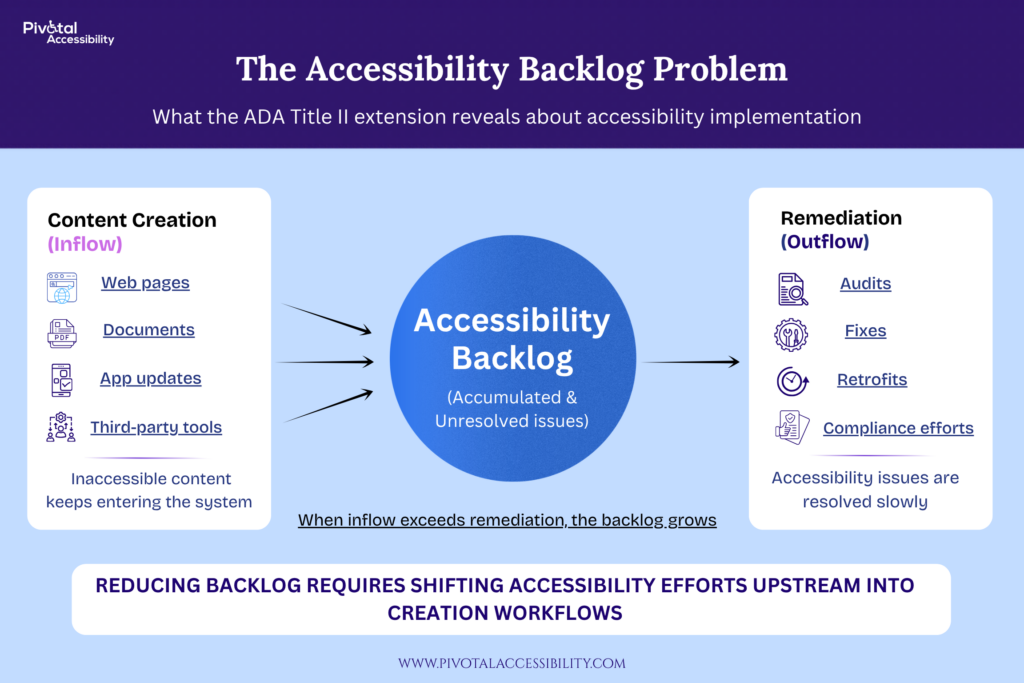
This dynamic can be understood as a system of inflow and outflow.
- New content introduces accessibility issues into the system
- Remediation efforts attempt to resolve them
When the rate of new inaccessible content exceeds remediation capacity, the backlog grows. The ADA Title II deadline extension underscores the need to shift accessibility upstream.
Accessibility must be integrated into:
- Content creation workflows
- Design systems
- Procurement and vendor processes
The rate at which new issues are introduced can be reduced if organizations implement accessibility at the ideation and production stages.
Without this shift, remediation efforts will continue to operate against a continuously expanding backlog.
ADA Title II Deadline Extension and the Role of Generative AI in Creating Compliance Risk
The reference to generative AI in the IFR is significant.
Generative AI enables rapid and large-scale content creation across:
- Websites
- Documents
- Digital services
However, as the Department notes, such content is “potentially inaccessible.” This introduces a new category of risk.
Human production speed is no longer the constraint for accessibility. Automated content generation at scale increasingly influences it.
Without controls, this accelerates the introduction of accessibility issues beyond the capacity of remediation efforts.
ADA Title II Deadline Extension and Measuring Accessibility Progress Effectively
The Interim Final Rule highlights implementation challenges but does not define operational metrics.
Many organizations measure:
- Total accessibility issues
- Percentage compliance
These metrics do not capture whether accessibility is improving over time.
A more meaningful measure is whether organizations are reducing the rate of new inaccessible content.
As outlined in what a robust digital accessibility strategy must include in 2026, sustainable accessibility depends on embedding it into ongoing workflows rather than treating it as a one-time effort.
If inflow remains constant or increases, remediation efforts will not lead to sustainable compliance.
ADA Title II Deadline Extension and the Path Forward for Organizations
The ADA Title II deadline extension provides additional time, but it does not alter the conditions that led to the extension.
The IFR makes clear that:
- Technology has not matured as expected
- Resource constraints remain
- Content production continues to evolve
The effectiveness of the extension depends on whether organizations change how accessibility is implemented.
Without reducing the introduction of new accessibility barriers, organizations may face similar challenges at the revised deadlines.
The focus, therefore, is not only on compliance timelines, but on controlling how accessibility risk enters digital systems.
If your organization is evaluating how to manage accessibility backlog risks or align with ADA Title II requirements, you can get in touch with our team to discuss a structured approach to sustainable accessibility implementation.